Our History
The Department of Biostatistics of Dicle University Faculty of Medicine first began education in 1969 — initially within the Departments of Public Health and later Medical Biology — with the transfer of the students at Ankara University Faculty of Medicine to Diyarbakır.
Our department was established as the Department of Biostatistics in 1995 by Prof. Dr. M. Yusuf ÇELİK, within the Division of Basic Medical Sciences of the Faculty of Medicine.
In our country, the Department of Biostatistics was established within a Faculty of Medicine for the first time at our University's Faculty of Medicine.
The activities of our Department are planned so as to fulfill Education-Teaching, Research-Development, Practice and community services.
As the Department of Biostatistics, we carry out continuous research and develop advanced undergraduate and graduate education programs. In addition, we develop new methodology projects in order to increase our international competitiveness.
In the 30-computer-capacity Computer Laboratory of our Faculty of Medicine, undergraduate Biostatistics courses are taught in a hands-on manner, with each student taking part one-on-one at the computer for at least 4 hours. In addition, Biostatistics consultancy services are provided for scientific research conducted in the field of health sciences. On average, consultancy services are provided for 250 theses and scientific studies per year. As in the joint research we have conducted with the clinical sciences to date, through the studies we carry out with other disciplines as well, we contribute to the importance of the science of Biostatistics and to the acceptability of studies in international journals.
In addition, we draw attention to the importance of theoretical and applied Biostatistics education at our University, and to the necessity of having performed Biostatistical checks in order to increase the international competitiveness of scientific research. The joint studies we have carried out to date have shown that the Biostatistics terminology to be used at every step, from the planning stage to the reporting stage of a scientific study, makes an important contribution to the scientific strength of the study.
The faculty members of the Department, in addition to the Faculty of Medicine, provide undergraduate education at the Faculty of Dentistry, the Faculty of Pharmacy and the School of Health, and also teach graduate-level theoretical and applied courses at the Institute of Health Sciences.
Biostatistics Consultancy
Consultancy services are provided by the Department to scientific research (thesis studies and non-thesis studies) on the use of Biostatistics methods and principles, data analysis and interpretation of results, and responding to reviewer criticisms. Within the scope of this service, the following topics are covered:
- Examining the hypotheses and ensuring that they are presented in a testable form,
- Examining the type of research,
- Deciding on the appropriate sample size,
- Deciding on the appropriate sampling method,
- Examining the data collection methods,
- Deciding on the data analysis methods,
- Data analysis,
- Correct interpretation and presentation of the findings,
- Determining the limit of generalizability of the results.
Our Mission
Our mission is to deliver Biostatistics, Quality and Medical Informatics processes at the highest quality by providing — primarily at the Faculty of Medicine and across the university — education and consultancy services in the fields of biostatistics, quality and medical informatics; thereby enabling the training of professional groups and their making of correct decisions in their own fields, producing knowledge and technology of universal quality, and conducting research and publications of international quality.
Our Vision
Our vision is to be a department that provides education, research and consultancy services at the national and international level in the fields of Biostatistics, Quality and Medical Informatics.
Our Ethical Values
- Scientific approach,
- Being democratic,
- Respectability,
- Participativeness,
- Customer focus,
- Justice,
- Honesty,
- Sincerity,
- Sense of belonging
Our Policies
QUALITY POLICY
To be a department that prioritizes the satisfaction of students and of the academic staff served, that delivers education and statistical consultancy services in a timely manner, that ensures the continuous training and job satisfaction of its employees, that is respectful of the environment, that pioneers scientific development, that uses its resources effectively and efficiently, that adopts continuous improvement in its targeted areas as a goal, and that is honest, principled and committed to ethical values.
HUMAN RESOURCES POLICY
To create a development environment and opportunity for the continuous development of its employees and the realization of their potential.
ENVIRONMENTAL POLICY
To raise awareness throughout all our activities regarding our responsibilities to the environment and to ensure their participation.
OCCUPATIONAL HEALTH AND SAFETY POLICY
To establish the integrity of health, safety and the environment by reducing the emergency-situation risks that may arise within the framework of occupational health and safety rules.
INFORMATION SECURITY POLICY
To meet information security requirements by taking into consideration the legal conditions, the students and the academic staff served, and by taking into account existing and potential risks.
CUSTOMER SATISFACTION POLICY
To meet all demands without making any distinction between students and the academic staff served, and to develop the department's service process — within the framework of legal regulations and our means — with the suggestions of students, the academic staff served and our employees.
Duties, Authorities and Responsibilities
Our department, in addition to that which has become almost standard throughout the world, by also carrying out studies in the fields of Biostatistics, research, project preparation, quality, accreditation and medical informatics, fulfills the following functions:
1- Education and Teaching Activities
It covers undergraduate, graduate and in-service education.
2- Research and Development Activities
To provide statistical consultancy services for the research of those working in the health sciences, to carry out joint projects and publications with health sciences personnel, and in particular to develop Biostatistics methods applied to the health sciences and to conduct research.
3- Medical Informatics Activities
To develop new models for hospital services through information technologies, by using information technologies and the methods of medical work (diagnosis, treatment), education, communication, data and information collection, data and information processing, information management, medical decision-making and scientific analysis.
4- Quality and Accreditation
To graduate students equipped with knowledge and skills in the philosophy and practices of quality and accreditation in healthcare. To take part in efforts aimed at improving the quality level and quality of life of society. It aims to contribute to the development of the science of quality and accreditation in healthcare in Türkiye. Students will be able to reach a position where they can carry out, in their own institutions, the Quality and Accreditation in Healthcare efforts initiated under the leadership of the Ministry of Health.
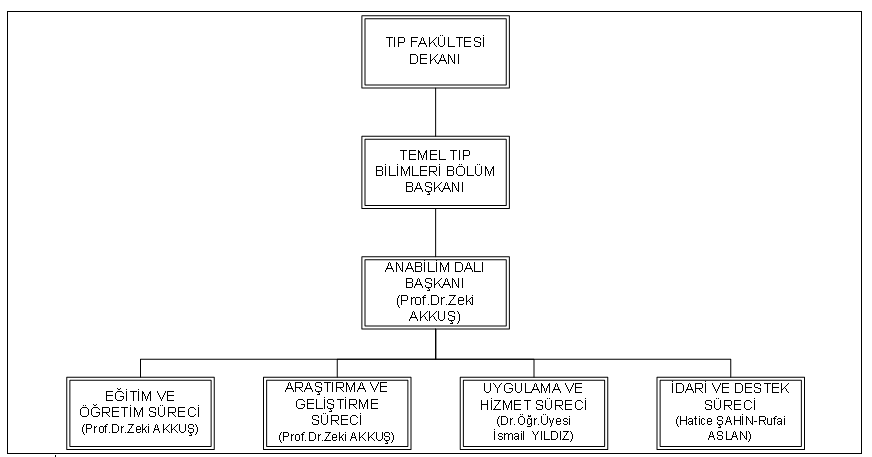
Organizational Structure (Organization Chart)
Services Provided (Service Quality Standards)
| No. | NAME OF THE SERVICE PROVIDED | DOCUMENTS REQUIRED FOR APPLICATION | SERVICE COMPLETION TIME (LATEST) |
|---|
| 1 | Formulation of research-related questions | Appointment Request Form/Phone/email | 1 Week |
| 2 | Designing and planning the study/experiment | Appointment Request Form/Phone/email | 1 Week |
| 3 | Research/Survey form design | Appointment Request Form/Phone/email | 1 Week |
| 4 | Formulating testable hypotheses | Appointment Request Form/Phone/email | 1 Week |
| 5 | Selecting the sampling method | Appointment Request Form/Phone/email | 1 Week |
| 6 | Calculating power/sample size | Appointment Request Form/Phone/email | 1 Week |
| 7 | Establishing the analysis plan | Appointment Request Form/Phone/email | 1 Week |
| 8 | Writing the statistical section | Appointment Request Form/Phone/email | 1 Week |
| 9 | Working on revisions for resubmission | Appointment Request Form/Phone/email | 1 Week |
| 10 | Protocol development | Appointment Request Form/Phone/email | 1 Week |
| 11 | Data collection | Appointment Request Form/Phone/email | 1 Week |
| 12 | Data management | Appointment Request Form/Phone/email | 1 Week |
| 13 | Data monitoring | Appointment Request Form/Phone/email | 1 Week |
| 14 | Statistical data analysis: deciding which method to use | Appointment Request Form/Phone/email | 1 Week |
| 15 | Interpretation of results | Appointment Request Form/Phone/email | 1 Week |
| 16 | Report/article preparation consultancy | Appointment Request Form/Phone/email | 1 Week |
| 17 | Definition of statistical methods | Appointment Request Form/Phone/email | 1 Week |
| 18 | Reviewing the article before submission for publication | Appointment Request Form/Phone/email | 1 Week |
| 19 | Responding to the criticisms received from reviewers | Appointment Request Form/Phone/email | 1 Week |
| 20 | Quality training and consultancy | Faculty Member Education/Research/Consultancy (EAD) Agreement | The time is determined according to the Situation Analysis. |
| 21 | Accreditation training and consultancy | Faculty Member EAD Agreement | The time is determined according to the Situation Analysis. |
| 22 | Strategic management training and consultancy | Faculty Member EAD Agreement | The time is determined according to the Situation Analysis. |
| 23 | Hospital information management systems consultancy | Faculty Member EAD Agreement | The time is determined according to the Situation Analysis. |
| 24 | Biostatistics course | Faculty Member EAD Agreement | 5 days |
| 25 | Quality and accreditation course | Faculty Member EAD Agreement | 5 days |
| 26 | Basic computer course | Faculty Member EAD Agreement | 5 days |
| 27 | Satisfaction surveys | Faculty Member EAD Agreement | 15 days |
SWOT Analysis
STRENGTHS OF YOUR UNIT
- 1. Being located in one of the country's leading Faculties of Medicine,
- 2. Education for qualified undergraduate students,
- 3. Strong cooperation with the clinical sciences and access to biological resources,
- 4. Taking part in international projects,
- 5. High motivation of the academic staff,
- 6. Having team spirit,
- 7. Having a team that will provide guidance in the fields of research and development.
WEAKNESSES OF YOUR UNIT
- 1. Insufficient number of research assistants,
- 2. Inability to obtain adequate support for congress participation,
- 3. Delay in project funds,
- 4. Lack of communication with international research centers,
- 5. Insufficiency in the supply of the rapidly developing biostatistics and informatics technology tools.
C. OPPORTUNITIES OF YOUR UNIT
- 1. Biostatistics being a priority area in project support,
- 2. Biostatistical developments finding a place in clinical applications,
- 3. Türkiye's membership in international research, education and exchange programs (FP6, Socrates, Erasmus).
D. THREATS TO YOUR UNIT
- 1. Researchers publishing incorrect research as a result of misusing ready-made software packages,
- 2. Ready-made software packages having been obtained by a large number of people without Biostatistics training,
- 3. Dependence on foreign countries for materials and fixtures and the associated high cost,
- 4. Limited young researcher staff,
- 5. Limited number and quality of student applications for postgraduate programs.
Strategic Objective of Your Unit
STRATEGIC OBJECTIVE
To provide undergraduate and graduate education at international standards, to increase the technological infrastructure and the investment in human resources aimed at developing research capacity, and to develop R&D capacity.
Strategic Goals
- SG1. To increase by 5% each year the capacity to provide undergraduate and graduate education at international standards in the fields of Biostatistics, Medical Informatics, and Quality and Accreditation in Healthcare,
- SG2. To invest 10% each year in the technological infrastructure and human resources aimed at developing research capacity,
- SG3. To prepare at least 1 project each year on Biostatistics/Quality/Accreditation/Medical informatics technologies.
Photo Gallery
[Photo gallery]